
Subansiri Lower HEP will be Started to Commission from December, 2024.

MONOJ GOGOI 

The 2000 MW Subansiri Lower Hydroelectric Project which construction work is undergoing at Gerukamukh ( the project site) in the West Siang of Arunachal Pradesh and Dhemaji districts Assam will be commissioned by December 2024. This was recently revealed to the media by Rajeev Kumar Vishnoi, Chairman and Managing Director (CMD) of National Hydroelectric Power Corporation (NHPC) Ltd. All the eight units, comprising 250 MW each will be commissioned by the end of 2024.

This one is one of the major projects of NHPC Ltd and after completion it will add 4 percent to the total hydro power generation of India. 
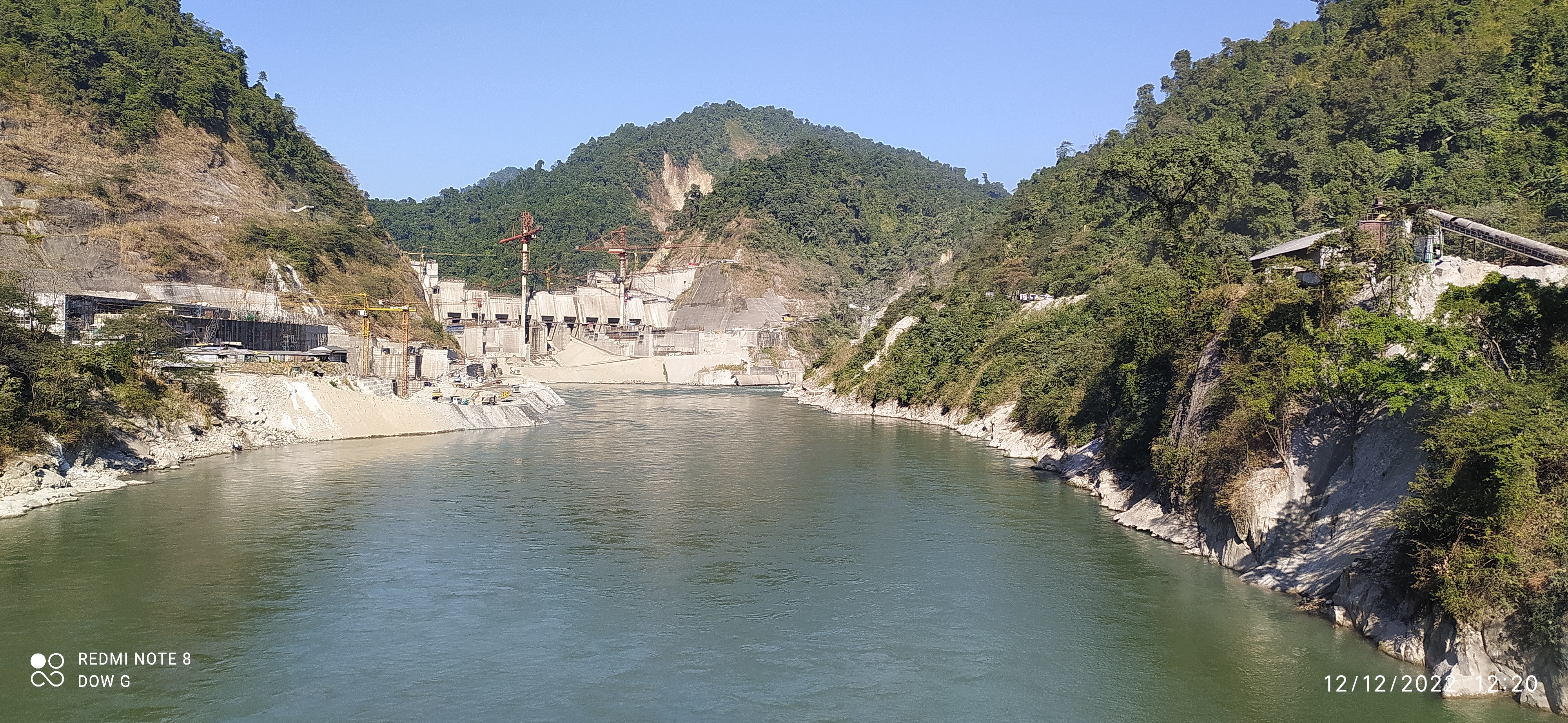
A file photo of the project site.

Earlier several deadlines were set to complete the project but each time it failed for several reasons. If the project is finished by the end of 2024, it would take more than two decades in developing the project. Due to time overrun cost overrun also took place. The estimated cost of the project Rs 21,274.54 crore (provisional) at December 2022 price level but Rs 6,285.33 crore at December 2002 price level was sanctioned by the Cabinet Committee on Economic Affairs (CCEA).


What will be gained by Assam and Arunachal Pradesh:

The project is situated on the border of Assam and Arunachal Pradesh. Therefore,  both the states expect economic benefits from the project. According to Vishnoi 533 MW of electricity has been allocated to Assam which includes 25MW free power to the state. On the other hand, the allocated power for Arunachal Pradesh is 274MW. The 240 MW free power to the state is included in the total allocated power. 

Comments

Popular posts from this blog

LOW YIELD OF BETEL NUTS HITS RURAL ECONOMY IN ASSAM THIS YEAR

MONOJ GOGOI   It's the harvesting period of betel nut or supari (areca nut) in Assam. But the yield of betel nuts is discernibly low this year in all the districts of Assam compared to previous years.       Chandan Boro, who plucks betel nuts, with Ranjit Basumatary and Raju Basumatary in this season in various villages under Gogamukh revenue circle of Dhemaji district in Assam says that in this harvesting season of betel nuts they are not getting as much works as they did in previous years. He says in the orchards where we plucked 20 quintals last year, this year's yield in the same orchard is less than 5 quintals. In many trees not even a single nut is found and in which trees nuts are there, it's comparatively very few.    Ranjit Basumatary says we are roaming from village to village but the situation is the same. "We are shocked to see the drastic change in the crop yields", he adds.    Biren Pegu, a betel nut grower from Goroimari are...

Saving Assam's Communities: A Scientific Approach to Riverbank Erosion

MONOJ GOGOI   The riverbank erosion is one of the major problems in Assam. The riparian community in the Brahmaputra basin in Assam has been bearing the brunt of erosion for decades. They lose properties, houses, homestead land and agricultural lands to erosion. The riverbank erosion, sometimes, engulfs even an entire settlement or village and thus displaces thousands of people annually in the state. According to a report, the state has already lost more than 4.27 ha of land to the  erosion caused by the Brahmaputra and its tributaries. There is no any mantra or strategy to stop suddenly the increasing trend of the erosion but scientific studies like “Mapping riverbank erosion and assessing it's impact on socio-economy and livelihood of people in selected villages in Lakhimpur and Majuli district: A case study for sustainable policy intervention to improve disaster and climate resilience of vulnerable communities”, prepared by Partha J Das (lead author) and Arup Kr. Das (remot...

ASIAN ELEPHANT: KILLING FOR SKIN

UNDERCOVER INVESTIGATION REVEALS ASIAN ELEPHANTS ARE FACING HUGE THREAT FROM POACHERS MONOJ GOGOI The elephant population is decreasing drastically due to habitat loss, forests fragmentation, traditional migratory routes blockade due to agricultural or other developmental activities outside protected areas. Therefore man-elephant conflicts are also increasing in many parts of the world. Due to high monetary value of ivories, skins and some other limbs of the body in international markets, the African and Asian elephants became easy prey of the poachers. But trading of ivory was internationally banned in 1989 and it could not help in distracting the poachers eyes from the pachyderm. The Asian Elephant (Elephas maximus), classified as endangered according to the International Union of Conservation for Nature (IUCN), faces huge threat from the poachers, particularly in Myanmar, but it doesn't mean that this species is safe in other South Asian countries. But Myanmar is ...